You’re Not Burned Out on Dating. You’re Burned Out on Performing It.
The loneliness epidemic is real, the data is damning, and the apps are making money off both.
Let’s start with what the numbers are actually saying, because most people haven’t seen them laid out plainly.
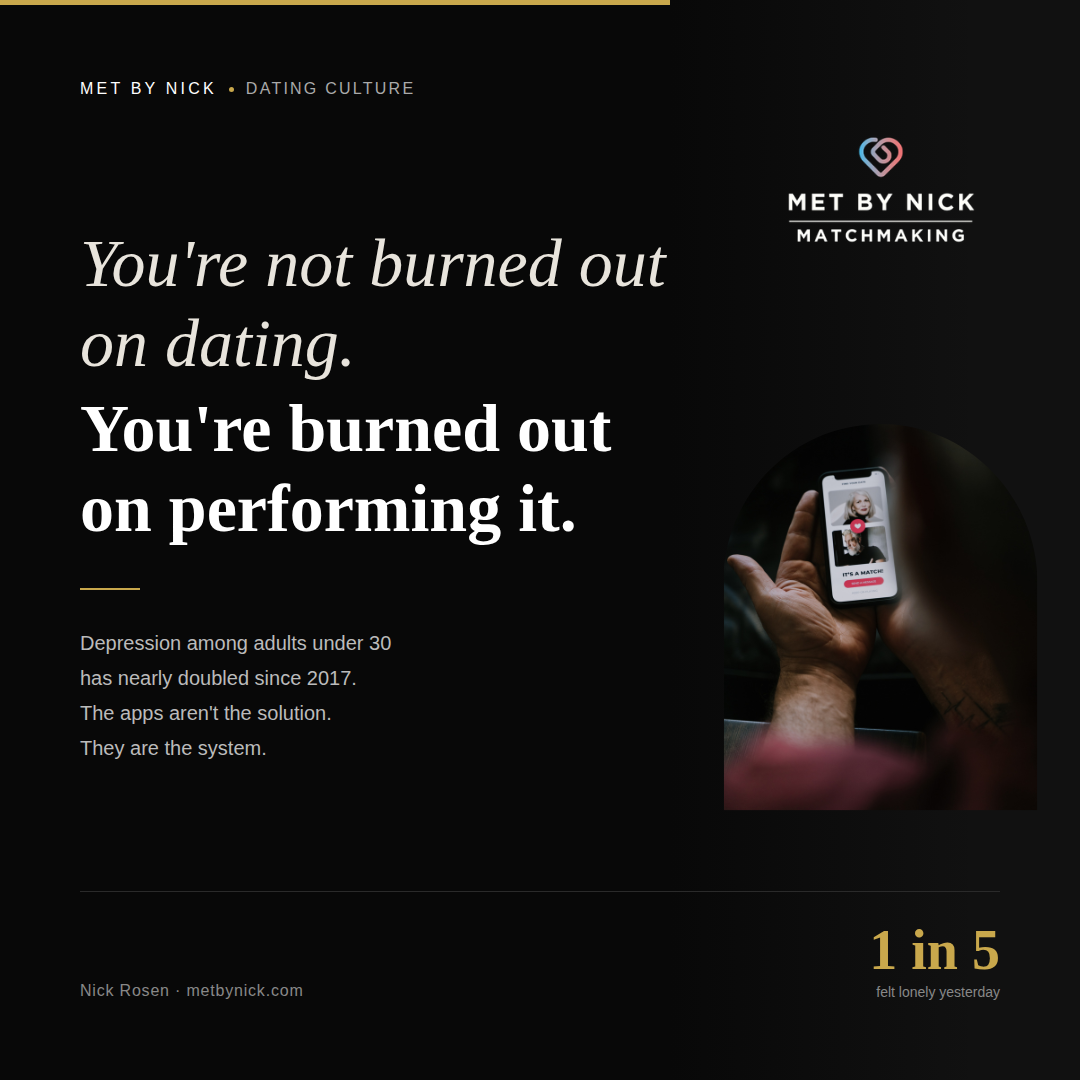
Gallup just published data showing that depression among U.S. adults has climbed from 13.5% to 18.3% since 2017. That’s not a blip. That’s nearly one in five Americans currently depressed or being treated for it. Among adults under 30, the rate has nearly doubled — from 13% to 26.7% in eight years. Among 30 to 44 year olds, it jumped from 14.2% to 21.5%. The two age groups most actively dating in this country are also the two age groups experiencing the sharpest deterioration in mental health on record.
The loneliness data is just as stark. As of Q2 2025, 21% of U.S. adults reported feeling lonely a lot of the previous day. That’s back up to 2021 pandemic-era levels, after a brief improvement in the years between. Loneliness is climbing fastest among adults 30 to 44 — up 6 percentage points since early 2023. These are not fringe statistics about vulnerable populations. These are the people downloading Hinge on a Thursday night, optimizing their bios, and wondering why nothing is working.
This is the population the apps are selling hope to. And the apps are doing extraordinarily well.
The Business Model Nobody Wants to Say Out Loud
Dating apps don’t profit from you finding a partner. They profit from you continuing to look. Those are not compatible incentives, and the entire architecture of the product reflects that reality.
Think about what a dating app actually does when you open it. It gives you a queue of strangers assessed entirely by photographs and a handful of sentences. It gamifies your appeal through a matching algorithm you cannot see or audit. It notifies you when someone likes you; a variable reward delivered on an unpredictable schedule, which is the same psychological mechanism that makes slot machines so effective. It charges you extra to see who already swiped right on you. It tells you your profile is losing visibility to nudge you into upgrading. It resurfaces old matches when engagement drops. It is, from interface to monetization strategy, a machine optimized to keep you in a state of low-grade anticipation; never quite satisfied, never quite ready to leave.
This is not an accident. It is the product.
The apps understood early that loneliness is not a problem they need to solve, it’s a condition they need to maintain at a manageable level. Resolve the loneliness and you lose the user. Keep them lonely but hopeful and you have a subscriber. The sweet spot is exactly where most people on dating apps find themselves: not lonely enough to quit, not connected enough to leave.
That psychological holding pattern has a name. It’s called engagement. And the apps are very, very good at it.
What Escapism Looks Like When It’s Dressed Up as Connection
We live in a genuinely hard moment. The depression spike among younger adults didn’t materialize out of nowhere. It emerged from a decade of compounding pressure: economic instability, institutional distrust, social fragmentation, a news cycle calibrated for maximum agitation, and careers that have colonized every waking hour. People are exhausted in a way that is hard to articulate but impossible to miss. They are not failing to connect because they aren’t trying. They are failing to connect because they are depleted, and they are being handed a product that was designed for a depleted person.
Dating apps are a perfect product for an exhausted culture for one specific reason: they require almost nothing from you. You don’t have to be present. You don’t have to be emotionally available. You don’t have to take a risk or say something true about yourself. You just have to scroll. And in a world where actual vulnerability feels genuinely costly, where showing up as yourself carries real social risk, the low-stakes fiction of swiping is a profound relief.
The problem is that it doesn’t go anywhere. It is movement without progress. It generates the sensation of actively trying without requiring any of the things that actual connection demands. And because it mimics the experience of dating without replicating its outcomes, it is uniquely good at producing a particular kind of demoralization: the feeling that you’ve been doing everything right and it still isn’t working.
That feeling is not a character flaw. It’s a design outcome.
The Mechanics of Exploitation, Laid Bare
Let’s be specific about what the apps are actually doing, because the language of “engagement” and “gamification” can make it sound more abstract than it is.
The swipe mechanic reduces human beings to a binary. Left or right. Yes or no. Before a word has been exchanged, before a laugh has been shared, before any of the actual information that determines compatibility has been surfaced, you have made a judgment and moved on. This trains users to evaluate people the way they evaluate products: quickly, visually, disposably, and then to be surprised when that approach doesn’t produce intimacy.
The algorithmic matching system is a black box that none of the apps will meaningfully explain, which means users cannot understand why they are or aren’t seeing certain people. This uncertainty is functional. It keeps users guessing, adjusting, trying new photos, rewriting their bios, wondering if the problem is them. The app offers no feedback and no transparency, which means the user is left in a permanent state of self-interrogation. Am I not attractive enough? Too selective? Is my opening line wrong? The app has no incentive to answer these questions honestly, because an honest answer might end the search.
Paid tiers are structured to extract money at the exact moments of maximum vulnerability. When you’ve just had a string of bad dates and you’re wondering if there’s someone better out there, the app offers you Boost, a way to be seen by more people for a fee. When you’re curious who already liked you, the app charges you to find out. These upsells are not random. They are timed to the emotional low points in the user journey, because that is when people are most willing to spend.
Push notifications are designed to interrupt, not inform. “Someone liked your photo.” “You have a new match.” “Don’t let this connection expire.” These are not messages about your love life. They are re-engagement triggers, identical in function to the notifications that bring you back to Instagram or pull you into another hour of TikTok. The content is romantic. The mechanism is attention extraction.
And then there is the subscription itself, which is structured to auto-renew because the app knows that the moment of most likely cancellation, the moment you feel settled, satisfied, no longer searching, is also the moment you’re least likely to be thinking about your credit card statement. The business model literally depends on your continued dissatisfaction.
What This Does to People Over Time
The cumulative effect of years inside this system is something I see regularly in the people I work with. It produces a specific set of distortions.
People start to believe that the feeling of connection they’re seeking is rarer than it actually is, because the app has shown them hundreds of people who didn’t work out. They develop a consumer relationship with potential partners — always wondering if there’s someone better, always reluctant to fully invest. They become skilled at the performance of early-stage dating: the banter, the bios, the first-date conversation, and increasingly bad at the harder, slower work of actually knowing someone. They are, in a word, optimized for the app and maladapted for the relationship.
None of this is their fault. It is what the system produces. And it happens gradually enough that most people don’t notice it until they’re exhausted, cynical, and genuinely unsure whether they want what they thought they wanted.
They still want it. They’ve just been trained out of believing they can have it.
What Genuine Connection Actually Requires
Real connection is slow, specific, and costly in ways that can’t be automated. It requires showing up as yourself before you know if you’re going to be received well. It requires tolerating uncertainty that isn’t mediated by an algorithm. It requires making a judgment about someone based on who they actually are, not who they appear to be in seven curated photographs.
None of that is comfortable. All of it is necessary.
The people I’ve watched build real relationships share a few things in common. They stopped outsourcing the process. They got honest about what they actually needed rather than what they thought they were supposed to want. They invested in being ready for connection rather than in being better at finding it. And they stopped treating the search as a performance and started treating it as something that required their genuine presence.
That shift is not small. In a culture that has commodified dating and automated loneliness management, choosing to actually show up is a genuinely countercultural act.
You are not a conversion rate. You are not a match percentage. You are a person navigating one of the stranger and harder periods in recent American life, and you deserve a path to partnership that takes that seriously.
The apps don’t. And the data: rising depression, climbing loneliness, a generation of young adults twice as likely to be depressed as they were eight years ago, is the cost of pretending otherwise.
You can stop paying it.
Nick Rosen is the founder of Met By Nick and co-founder of QUALITY, a matchmaking and dating coaching practice operating across North America. He works with real people who are done with the performance and ready for the real thing.
Sources:
Witters, Dan. “U.S. Depression Rate Remains Historically High.” Gallup, September 9, 2025. https://news.gallup.com/poll/694199/u.s.-depression-rate-remains-historically-high.aspx