Why I Stay: A Matchmaker’s Confession in the Age of Dating Despair
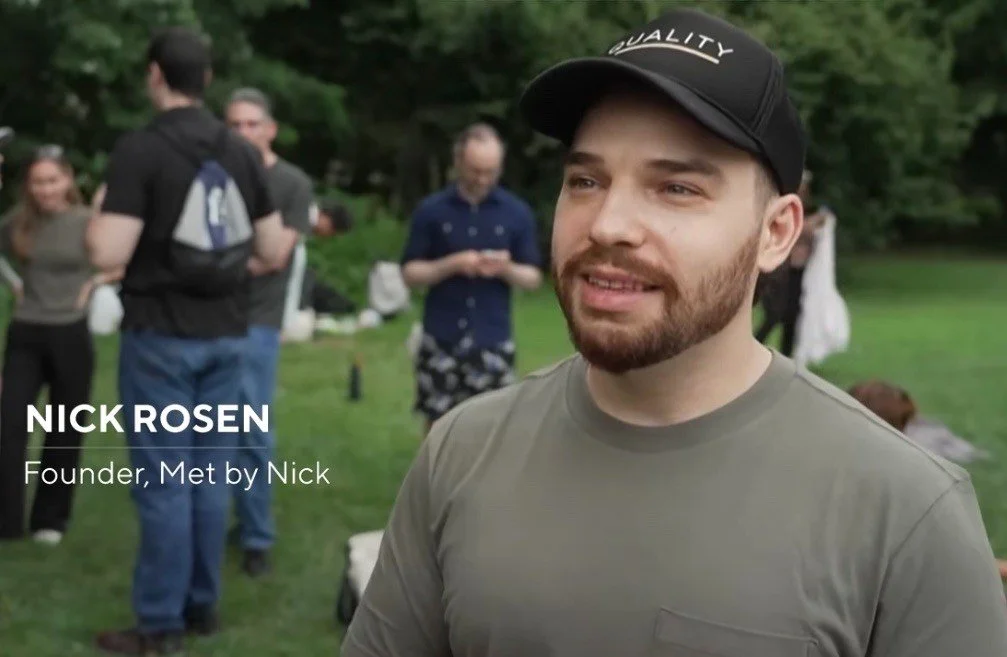
Nick Rosen, Professional Matchmaker and Founder of Met By Nick
When you work as a professional matchmaker, you don’t get the luxury of viewing modern dating through rose-colored glasses. You’re in the trenches, hearing the raw truth about what people are experiencing out there. And honestly? It can be soul-crushing.
I hear it all. The frustration that bleeds through every conversation. The loneliness that people carry like a weight they’ve forgotten how to put down. The isolation of swiping through hundreds of faces and still feeling invisible. The exhaustion of not being heard, of shouting into the void of dating apps and getting only silence or cruelty in return.
The horror stories pile up in my inbox and spill out during consultations. People who’ve been ghosted after months of what felt real. Dates who turned out to be married. Someone’s time wasted, heart played with, dignity dismissed. I’ve heard them all, and each one lands heavy because these aren’t just stories, they’re people I’ve come to care about, people who trusted me enough to share their pain.
So here’s the question that keeps me up at night: Why do I continue doing this?
The Economics of Doubt
Let me be clear about something: this isn’t a side hustle. This isn’t a hobby I dabble in between other “real” work. Matchmaking is my profession, my livelihood. And in this business, success is measured in one unforgiving metric, whether someone gets into a relationship.
Not dates arranged. Not compatibility scores. Not feel-good moments or personal growth journeys. Relationships. Actual, committed partnerships between two people.
And here’s the uncomfortable truth: more and more people are choosing to opt out entirely. They’re choosing to be single not as a temporary state, but as a permanent stance. After years of disappointment, they’re walking away from the dating market altogether. Some with relief. Some with resignation. Some with bitterness they wear like armor.
So why would anyone build a career on something that an increasing number of people are deciding isn’t worth the effort?
Fighting Against Billion-Dollar Dopamine Machines
And let’s talk about the real elephant in the room: I’m competing against some of the most well-funded, psychologically sophisticated companies in the world.
Dating apps aren’t just popular, they’re engineered to be addictive. They’ve hired the best behavioral psychologists, the most talented UX designers, the sharpest minds in engagement optimization. They’ve raised billions in funding. They have marketing budgets that dwarf my entire annual revenue. They run on algorithms refined through millions of data points, designed to keep people swiping, scrolling, hoping.
They’ve gamified human connection.
Every swipe triggers a little dopamine hit. Every match feels like a win, even if it leads nowhere. The apps have turned dating into a slot machine — you keep pulling the lever because maybe, just maybe, the next one will pay out. The psychology is brilliant and insidious. People aren’t even dating anymore; they’re collecting matches like points in a game, getting their validation fix, feeling the thrill of possibility without ever having to face the vulnerability of real connection.
And here I am, one person with a modest operation, trying to convince people that there’s a better way.
It’s absurd, really. It’s David versus Goliath, except Goliath has machine learning, venture capital, and a user base in the hundreds of millions. What do I have? Conversations. Intuition. The old-fashioned belief that people are more than profiles.
How do you compete with that?
The Novelty Fades Fast
Let me dispel a myth: being a matchmaker isn’t glamorous. The novelty wears off approximately five minutes after your first complicated case, your first heartbroken client, your first match that seemed perfect on paper but combusted spectacularly in reality.
This is hard work. Emotionally draining work. Work that requires you to hold hope for other people even when they’ve run out of it themselves. Work that demands you believe in connection when everything around you, especially those dopamine-engineered apps, suggests that connection has become nearly impossible or, worse, obsolete.
I’m not obsessive about dating. I don’t spend my weekends binge-watching romantic comedies or swooning over celebrity couples. I’m not obsessive about relationships either, I know too much about how messy and complicated they can be to romanticize them.
But here’s what I am obsessive about: people.
The Real Fuel
What keeps me in this profession isn’t some fairy-tale belief in soulmates or destiny. It’s not even about love, if I’m being completely honest.
It’s about the people themselves.
Every single person who sits across from me, vulnerable and hopeful and scared, is carrying an entire universe inside them. Their stories are extraordinary. Their experiences, their quirks, their completely unique way of seeing the world, it’s endlessly fascinating. I get to meet the most incredibly cool people, and they trust me with the tender parts of themselves that they usually keep hidden.
The entrepreneur who built a business from nothing and can talk for hours about sustainable supply chains. The teacher who lights up when describing that one student who finally understood fractions. The engineer who collects vintage typewriters. The nurse who does stand-up comedy on weekends. The artist who’s also a semi-professional chess player. The accountant who’s passionate about bird conservation.
These are the people the apps reduce to a handful of photos and a few generic prompts. These are the people who get dismissed because they’re not six feet tall or they’re over forty or they don’t photograph well or they’re honest about wanting kids. These are the people whose complexity and depth get flattened into swipeable commodities.
Every day, I meet someone who deserves to be seen for who they actually are. And that’s what fuels me.
The Paradigm Shift
But there’s something bigger happening here, something that goes beyond my personal fascination with human stories.
My colleagues and I in the matchmaking space, we’re creating a paradigm shift in dating culture. We’re holding dating and romantic interactions to a higher standard.
We’re saying: No, you don’t have to accept being treated as disposable. No, ghosting isn’t just “how things are now.” No, you shouldn’t have to perform a carefully curated version of yourself to be worthy of someone’s time. No, connection isn’t supposed to feel this hollow and transactional. No, dating shouldn’t feel like a game where everyone’s expendable and no one’s really playing to win.
We’re saying: You are not a profile. You are not a commodity. You are not interchangeable with the next person in the queue.
We’re building something different. A model where people are approached as whole humans, not as profiles to be optimized or dopamine triggers to be exploited. Where compatibility is about more than algorithms and attraction is about more than a split-second swipe decision. Where the goal isn’t to gamify dating or maximize engagement metrics, but to facilitate genuine human connection.
Is it working? Slowly. Too slowly for some people’s patience, I know. And yes, I’m fighting an uphill battle against companies with unlimited resources and addictive products. But I see it happening. One thoughtful match at a time. One couple who met through intention rather than infinite scrolling. One person who steps off the dopamine treadmill and remembers what it feels like to be truly seen and heard, maybe for the first time in years.
Why I Stay
So yes, the work is hard. Yes, the market is discouraging. Yes, I’m building a career on something that feels increasingly countercultural. Yes, I’m up against billion-dollar companies that have turned loneliness into a profit center and connection into a game.
But I stay because I want purpose in my life. I want to feel like I’m doing something that will have an impact, even if that impact is one couple at a time, one life story at a time, one person who decides to try again because someone believed they were worth the effort.
I stay because I want to prove that there’s an alternative to the dopamine-fueled chaos. That human connection doesn’t have to be gamified to be valuable. That slower, more intentional, more human-centered approaches can still work in a world obsessed with scale and speed and optimization.
I stay because every time I match two people who actually fit, who see each other and choose each other with clear eyes and open hearts, I’m reminded that connection is still possible. It’s just buried under layers of bad systems, worse incentives, and algorithmic manipulation designed to keep people engaged but never quite satisfied.
I stay because someone has to keep believing when others have stopped. Someone has to stand up and say that people deserve better than what the apps are selling.
And mostly, I stay because the people I meet are just too damn interesting to walk away from. Their stories matter. Their hopes matter. Their incredibly specific combination of experiences and interests and values and dreams, it all matters. And none of it can be captured in a profile optimized for maximum swipes.
That’s why I’m still here, in the thick of it, holding space for possibility in an age of dating despair. Fighting the good fight against forces with far more money and reach than I’ll ever have.
Because the work isn’t really about dating at all.
It’s about seeing people. Really seeing them. And helping them see each other. It’s about refusing to let human connection be reduced to a dopamine delivery system.
And that? That’s worth staying for. That’s worth fighting for.
Even against impossible odds.