The Illusion of Choice: How Dating Apps Create False Autonomy for Modern Singles
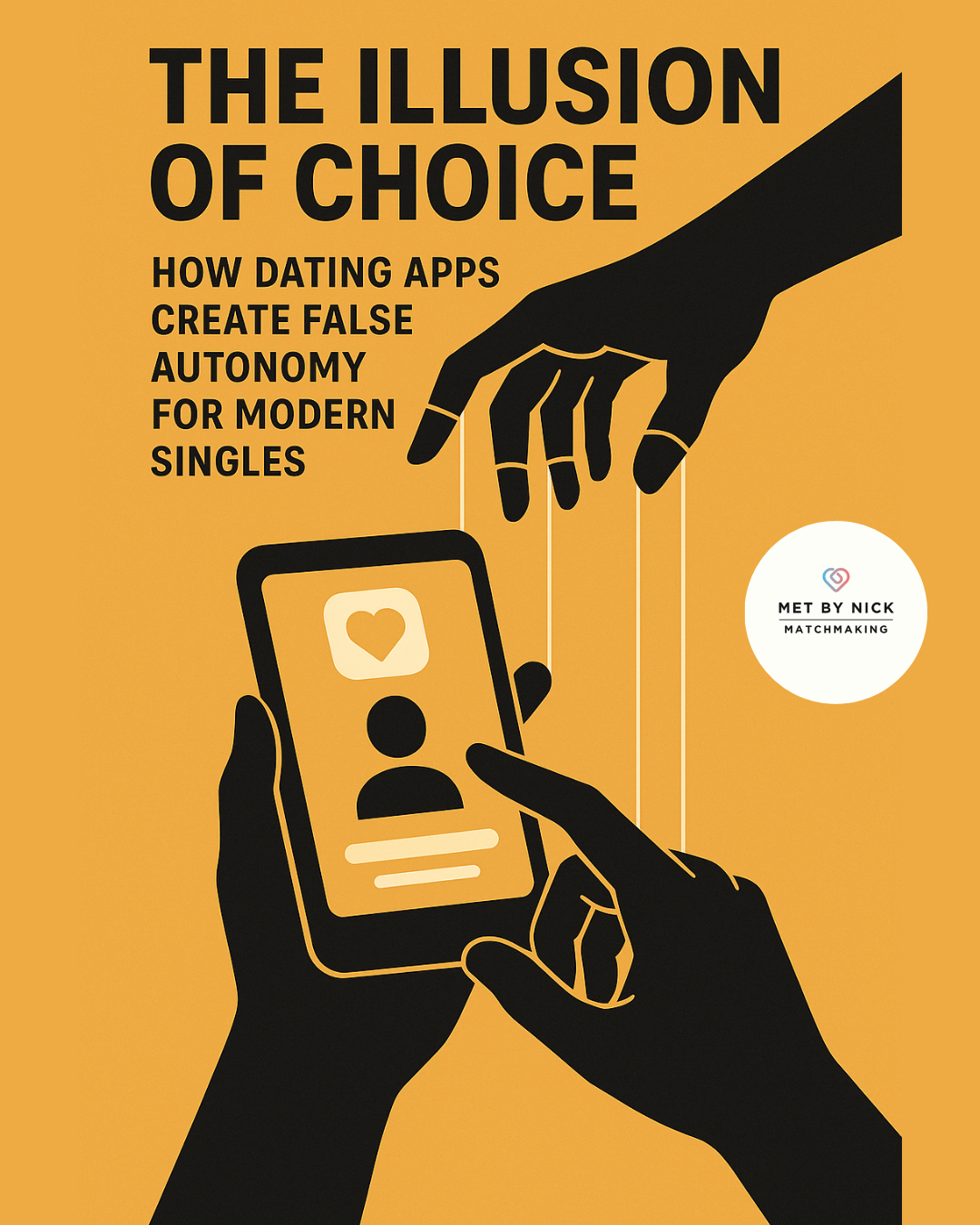
Bottom line up front: While major dating apps like Hinge, Bumble, Tinder, and Match promise unprecedented control over your love life, they actually create a sophisticated illusion of autonomy that leaves users more vulnerable, exhausted, and disconnected than ever before.
The Promise vs. The Reality
Dating apps market themselves as liberation tools; promising to free singles from the awkwardness of blind dates, family setups, and chance encounters. They present an appealing narrative: you’re in control, you choose who to see, and you can filter potential partners based on your exact preferences without outside interference.
But this perceived autonomy is fundamentally false, and mounting research evidence reveals the psychological toll this illusion takes on millions of users worldwide.
Four Ways Dating Apps Undermine Real Autonomy
1. Your Public Image Is at Risk and Beyond Your Control
Despite the illusion of privacy, dating apps expose users to unprecedented public judgment and vulnerability. A systematic review of dating app research found that over 85% of studies examining body image reported significant negative impacts, largely because users are constantly being evaluated and rated by strangers.
Your “mistakes” and rejections don’t stay private; they become social media content, screenshots shared among friends, and data points in algorithms you can’t see or control. The apps themselves profit from your data, creating detailed psychological profiles that are used not just for matching but for advertising and behavioral manipulation.
Research shows that current dating app users have significantly higher rates of psychological distress, anxiety and depression compared to non-users, suggesting that this constant public evaluation takes a measurable mental health toll.
2. Family and Friends Still Influence Your Dating Choices
The promise of dating “without outside influence” crumbles under scrutiny. Most singles report they can only date within certain ethnic groups, faith backgrounds, or political associations; restrictions that exist regardless of the dating platform used.
These limitations aren’t imposed by the apps; they’re internalized social and familial expectations that users bring to their swiping. The apps simply become a new venue for the same old constraints, while providing a false sense that you’re making “independent” choices.
3. You Have No Control Over Others’ Intentions or Authenticity
Perhaps the most damaging aspect of dating app “autonomy” is the complete lack of control users have over other people’s intentions and authenticity. This powerlessness has spawned an entire vocabulary of terms describing manipulative behaviors:
Breadcrumbing: Sending minimal messages to keep someone interested without commitment
Love bombing: Overwhelming someone with affection to manipulate them
Ghosting: Disappearing without explanation
Situationships: Undefined relationships that lack commitment
Pocketing: Hiding someone from your social circle
Roaching: Secretly dating multiple people
Orbiting: Staying connected on social media after ending romantic contact
Wokefishing: Pretending to have progressive values to attract matches
Marleying: Reappearing after extended silence (like Marley’s ghost)
Cloaking: Standing someone up and blocking them immediately
Hardballing: Being extremely upfront about relationship expectations
These terms exist because users desperately need language to describe experiences they cannot control but must navigate. The proliferation of this terminology reveals the systematic nature of these problems; they’re not isolated incidents but predictable outcomes of a system that prioritizes engagement over genuine connection.
4. The Apps Are Designed to Keep You Single and Swiping
The fundamental business model of dating apps creates a perverse incentive: success for users (finding lasting relationships) equals failure for the company (losing paying customers). The dating apps that promised to make finding love easier have somehow made it feel impossible, and this isn’t an accident.
Apps are optimized for engagement, not outcomes. They use variable reward schedules (the same psychological mechanism behind gambling addiction) to keep users hooked on the possibility of the next match, the next message, the next possibility.
The Statistical Reality of Dating App Failure
The research paints a stark picture of modern dating app effectiveness:
53% of singles report experiencing dating burnout occasionally or frequently
32% of people who once used dating apps have now quit entirely
78 percent of dating app users reportedly feel “emotionally, mentally, or physically exhausted” by them
Over 79% of adults have experienced burnout while using online dating apps
Half of singles say they are not currently looking for a relationship or dates
Multilevel growth curve models showed that dating app users experienced increased emotional exhaustion and inefficacy over time, meaning the longer you use these platforms, the worse you feel about your dating prospects.
Why More Singles Are Choosing to Be Alone
Half of American singles are not interested in a relationship or dating, and this isn’t necessarily a negative development. Many are making conscious decisions to prioritize their mental health and well-being over pursuing relationships through dysfunctional systems.
Research on voluntary versus involuntary singlehood shows that single young adults who perceive their singlehood as voluntary report higher levels of positive mental health and lower levels of romantic loneliness compared to those who feel their single status is involuntary.
The rise of intentional singlehood represents a rejection of systems that commodify human connection while promising autonomy they cannot deliver.
The Alternative: Authentic Accountability in Dating
Real autonomy in dating comes not from unlimited choice, but from accountability, intentionality, and genuine human connection. Professional matchmaking and secular matchmaking services offer a fundamentally different approach:
Accountability: Everyone in the dating community is held to standards of respectful behavior and honest communication.
Intentionality: Focus on people who are genuinely seeking partnership, not entertainment or validation.
Human-centered matching: Decisions are made by people who understand human psychology, not algorithms designed to maximize screen time.
Quality over quantity: Three thoughtful, vetted matches provide more value than three hundred random swipes.
What You Should Do
Recognize the illusion: Understand that major dating apps are designed to keep you engaged, not to help you find love. You are not a person with agency to them; you are a data point generating revenue.
Consider alternatives: Explore professional matchmaking services, social groups with shared interests, community events, and connections through friends who actually know and care about you.
Prioritize your mental health: When 53% of people are experiencing dating fatigue, they need a completely different approach. If dating apps are causing you stress, anxiety, or depression, taking a break isn’t giving up, it’s self-care.
Redefine success: True autonomy means having the freedom to choose how, when, and if you want to pursue romantic relationships. Sometimes the most empowered choice is deciding that the current options don’t serve your best interests.
Conclusion
The autonomy promised by dating apps is largely illusory. Real empowerment comes from recognizing these systems for what they are — engagement-driven businesses that profit from your romantic frustration — and choosing approaches that align with your actual goals and well-being.
Whether that means working with professional matchmakers, focusing on in-person connections, or embracing intentional singlehood, the key is making choices based on authentic self-knowledge rather than the false promise of infinite options.
In a world where the system isn’t designed to solve your problem, it’s designed to perpetuate it, the most radical act might be refusing to participate in systems that don’t serve your highest good.
Nick Rosen
Founder of Met By Nick and Co-Founder of QUALITY
Sources
ScienceDirect. “Dating apps and their relationship with body image, mental health and wellbeing: A systematic review.” November 2024. https://www.sciencedirect.com/science/article/pii/S0747563224003832
BMC Psychology. “Swipe-based dating applications use and its association with mental health outcomes: a cross-sectional study.” March 2020. https://bmcpsychology.biomedcentral.com/articles/10.1186/s40359-020-0373-1
Met By Nick. “Modern Dating Statistics 2025: What 5,000 Singles Revealed About Dating Today.” July 2025. https://metbynick.com/blog/modern-dating-statistics-2025-what-5000-singles-revealed-about-dating-today
Women’s Health Magazine. “What Drives Dating App Fatigue — And What Singles Can Do About It.” September 2024. https://www.womenshealthmag.com/relationships/a62081332/dating-app-fatigue-burnout/
New Media & Society. “Burnt out and still single: Susceptibility to dating app burnout over time.” Sharabi, L.L., Von Feldt, P.A., & Ha, T. October 2024. https://journals.sagepub.com/doi/abs/10.1177/14614448241286788
PMC (PubMed Central). “Dating Apps and Their Sociodemographic and Psychosocial Correlates: A Systematic Review.” September 2020. https://pmc.ncbi.nlm.nih.gov/articles/PMC7557852/
Dating Advice. “8 Online Dating Burnout & Swipe Fatigue Statistics (2025).” May 2025. https://www.datingadvice.com/online-dating/swiping-fatigue-burnout-study
Peter McGraw. “The Statistics Of Single Living.” July 2023. https://petermcgraw.org/the-statistics-of-single-living/
Pew Research Center. “A profile of single Americans.” February 2025. https://www.pewresearch.org/social-trends/2020/08/20/a-profile-of-single-americans/
Cyberpsychology Journal. “The relationship between preference for online social interaction and affective well-being via compulsive dating app use.” September 2023. https://cyberpsychology.eu/article/view/21419
PMC (PubMed Central). “Voluntary and Involuntary Singlehood and Young Adults’ Mental Health.” 2017. https://pmc.ncbi.nlm.nih.gov/articles/PMC5696487/
Sage Journals. “Dating Apps: The Uncertainty of Marketised Love.” Bandinelli, C. & Gandini, A. 2022. https://journals.sagepub.com/doi/10.1177/17499755211051559
ResearchGate. “The Self-Esteem, Loneliness, and Psychological Well-Being of Online Dating App Users: A Mixed Method Study.” September 2024. https://www.researchgate.net/publication/383647380_The_Self-Esteem_Loneliness_and_Psychological_Well-Being_of_Online_Dating_App_Users_A_Mixed_Method_Study