The Addiction Economy: How Dating Apps Turned Love Into a Slot Machine
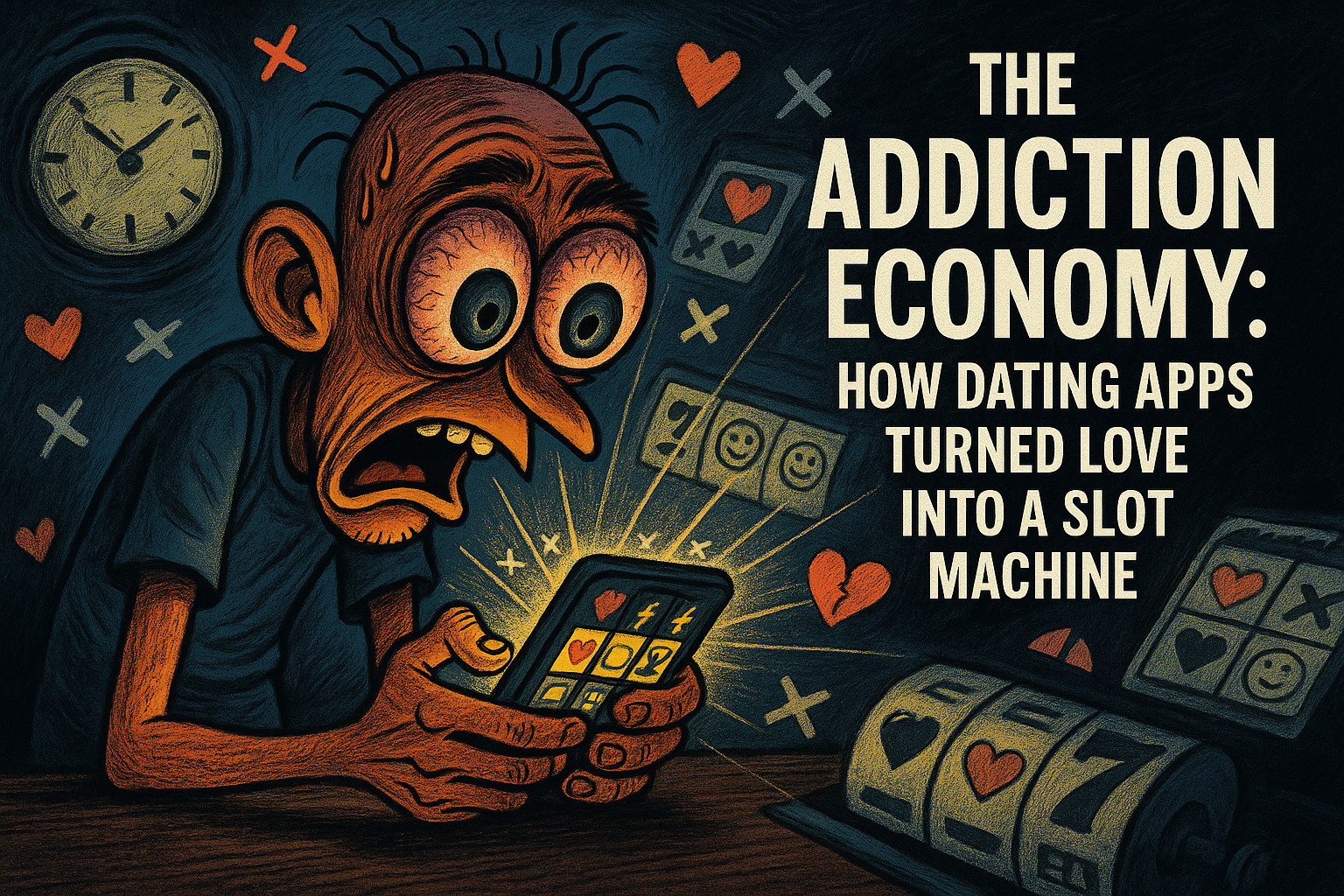
We’re living through a dystopian transformation of human connection, one where the search for love has been weaponized against our own wellbeing. Dating apps haven’t just changed how we meet people; they’ve fundamentally altered our relationship with romance itself, turning what should be one of life’s most meaningful experiences into a compulsive, profit-driven game.
The evidence is overwhelming: dating app companies are predatory by design, employing the same psychological manipulation tactics used by casinos and social media platforms to create addiction. Their primary motivation isn’t your happiness or relationship success; it’s keeping you hooked, paying, and perpetually searching.
The Neurochemical Hijacking of Love
Dating apps have mastered the art of exploiting our brain’s reward system. Every swipe triggers a small release of dopamine; the same neurotransmitter involved in gambling addiction, drug dependency, and other compulsive behaviors. But unlike naturally occurring dopamine responses, app-based rewards follow what psychologists call a “variable ratio reinforcement schedule.”
This is the same mechanism that makes slot machines so devastatingly effective. You never know when the next swipe will produce a match, creating an unpredictable reward pattern that research shows is the most addictive form of behavioral conditioning. Your brain becomes trained to crave the next potential match, regardless of whether these matches lead to meaningful connections.
The result is profound: users report feeling anxious when they can’t check their apps, experiencing withdrawal-like symptoms when attempting to delete them, and finding themselves mindlessly swiping even when they don’t want to be dating. Studies indicate that heavy dating app users show neurological patterns similar to those found in gambling addicts and individuals with substance use disorders.
The Gamification Trap: When Humans Become Playing Pieces
Dating apps have systematically gamified human connection, reducing complex individuals to a series of game mechanics designed to maximize engagement and revenue. Consider the predatory design elements now standard across major platforms:
Artificial Scarcity and FOMO: Features like “limited daily likes” create false urgency, pressuring users to act quickly without thoughtful consideration. Premium subscriptions promise unlimited likes, exploiting the fear of missing out on potential connections.
Variable Reward Systems: The unpredictability of matches creates psychological tension that keeps users returning compulsively. You never know if the next swipe will be “the one,” so you keep playing.
Achievement Mechanics: Super likes, boosts, and premium features are presented as power-ups that improve your chances, mimicking video game progression systems. Users are conditioned to believe that spending more money equals better outcomes.
Social Validation Loops: Match notifications and profile views provide intermittent social validation, creating dependency on external approval for self-worth.
Endless Scrolling: The infinite feed design prevents natural stopping points, encouraging hours of mindless engagement.
The Predatory Business Model Exposed
The dating app industry operates on a fundamental conflict of interest: their profits depend entirely on keeping users single and searching. A successfully matched couple represents two lost customers, while frustrated singles are perpetual revenue sources.
This creates perverse incentives that prioritize engagement over outcomes:
Algorithmic Manipulation: Apps deliberately limit organic reach, showing your profile to fewer potential matches unless you pay for boosts. The algorithm is designed to create just enough success to maintain hope while ensuring you never quite achieve your goals.
Premium Feature Addiction: Once users invest in premium features, they become psychologically committed to the platform. The sunk cost fallacy keeps them paying monthly fees for marginal improvements in visibility or functionality.
Data Harvesting for Profit: Your most intimate preferences, insecurities, and behavioral patterns become valuable data sold to advertisers and used to refine manipulation techniques.
Manufactured Competition: Apps create artificial competition by inflating user numbers, promoting unrealistic standards, and encouraging users to constantly seek “better” options rather than invest in existing connections.
The Mental Health Crisis Hidden in Plain Sight
The psychological toll of dating app addiction extends far beyond frustrated romantic lives. Research consistently demonstrates serious mental health consequences associated with heavy app usage:
Increased Depression and Anxiety: Studies show direct correlations between dating app usage time and elevated rates of depression and anxiety disorders. The constant rejection, comparison, and validation-seeking create persistent psychological stress.
Body Dysmorphia and Self-Esteem Issues: The emphasis on physical appearance and instant visual judgments exacerbates body image problems and erodes self-worth. Users report obsessing over photo selection and physical appearance in ways that negatively impact daily functioning.
Attention and Focus Problems: The dopamine dysregulation caused by variable reward schedules impairs users’ ability to focus on other activities, affecting work performance and personal relationships.
Relationship Anxiety: Paradoxically, heavy app users often develop increased anxiety about real-world dating and relationships, having become accustomed to the artificial safety of digital interaction.
Sleep Disruption: Many users report late-night swiping sessions that interfere with healthy sleep patterns, creating cascading effects on physical and mental health.
The Illusion of Choice and Connection
Dating apps market themselves as expanding your options and increasing connection opportunities. In reality, they’ve created an illusion of abundance that actually impairs our ability to form meaningful relationships.
The “paradox of choice” demonstrates that too many options often lead to decision paralysis and decreased satisfaction with chosen outcomes. Dating apps amplify this phenomenon exponentially, presenting users with seemingly infinite possibilities while making it psychologically difficult to commit to any single person.
This creates what researchers call “relationship shopping behavior” — constantly seeking someone better rather than investing in existing connections. Users develop unrealistic standards, always wondering if the next swipe might reveal someone more attractive, successful, or compatible.
The apps profit from this mindset, encouraging users to maintain premium subscriptions while perpetually searching for upgrades rather than building relationships with current matches.
The Social Engineering of Loneliness
Perhaps most disturbing is how dating apps have systematically engineered solutions to problems they help create. By making organic social connection more difficult and less rewarding than digital interaction, they’ve positioned themselves as essential utilities for modern romance.
Consider how app usage patterns reinforce social isolation:
Users spend hours engaging with digital profiles instead of attending social events
The convenience of app-based dating reduces motivation to develop real-world social skills
Failed app experiences create cynicism about dating that carries over into offline interactions
The addictive nature of apps consumes time and mental energy that could be invested in existing relationships
The result is a generation increasingly dependent on these platforms for social connection while simultaneously becoming less capable of forming relationships without them.
Breaking Free from the Algorithm
Recognizing dating app addiction is the first step toward reclaiming agency over your romantic life. Warning signs include:
Compulsive checking despite negative emotional responses
Spending more than 30 minutes daily on dating apps
Anxiety when unable to access apps
Prioritizing app usage over real-world social activities
Continuing to use apps despite consistently poor outcomes
Feeling controlled by match notifications and app features
The solution isn’t better apps or more mindful swiping; it’s recognizing that your romantic wellbeing is too important to entrust to systems designed to exploit your psychological vulnerabilities.
Reclaiming Human Connection
We’ve allowed billion-dollar corporations to colonize one of humanity’s most fundamental experiences: the search for love and companionship. These companies have convinced us that their profit-driven algorithms know better than our own instincts, communities, and social networks.
It’s time to reject this dystopian experiment in commodified romance. Your capacity for love, connection, and partnership deserves better than being reduced to engagement metrics and revenue streams.
The path forward requires acknowledging an uncomfortable truth: dating apps aren’t just failing to help us find love, they’re actively preventing it by rewiring our brains to crave the search itself rather than the meaningful connections it should produce.
Breaking free means choosing systems and approaches that prioritize your wellbeing over corporate profits, that treat you as a complete human being rather than a data point, and that understand the difference between helping you find love and keeping you addicted to looking for it.
Your romantic future is too precious to gamble away on rigged slot machines disguised as digital matchmaking services.
Sources
Birches Health. “Dating Apps Addiction.” Available at: https://bircheshealth.com/resources/dating-apps-addiction
National Center for Biotechnology Information. “The psychology of dating app addiction and its implications for mental health.” PMC Article PMC10864872. Available at: https://pmc.ncbi.nlm.nih.gov/articles/PMC10864872/
Science Direct. “Compulsive use of dating applications: Prevalence and association with anxiety and depression symptoms.” Available at: https://www.sciencedirect.com/science/article/pii/S0736585323000138
Datopia. “Emotional Connections & Gamification: Dating App Gamification Engagement.” Available at: https://www.datopia.world/en/emotional-connections-gamification/dating-app-gamification-engagement/
University of Technology Sydney. “What makes us keep swiping? The psychology behind dating app addiction.” February 2024. Available at: https://www.uts.edu.au/news/2024/02/what-makes-us-keep-swiping