First Date Red Flags: The One Behavior 88% of People Reject (And Why It Predicts Relationship Success)
The Most Universal Dating Red Flag Just Got Confirmed by Data
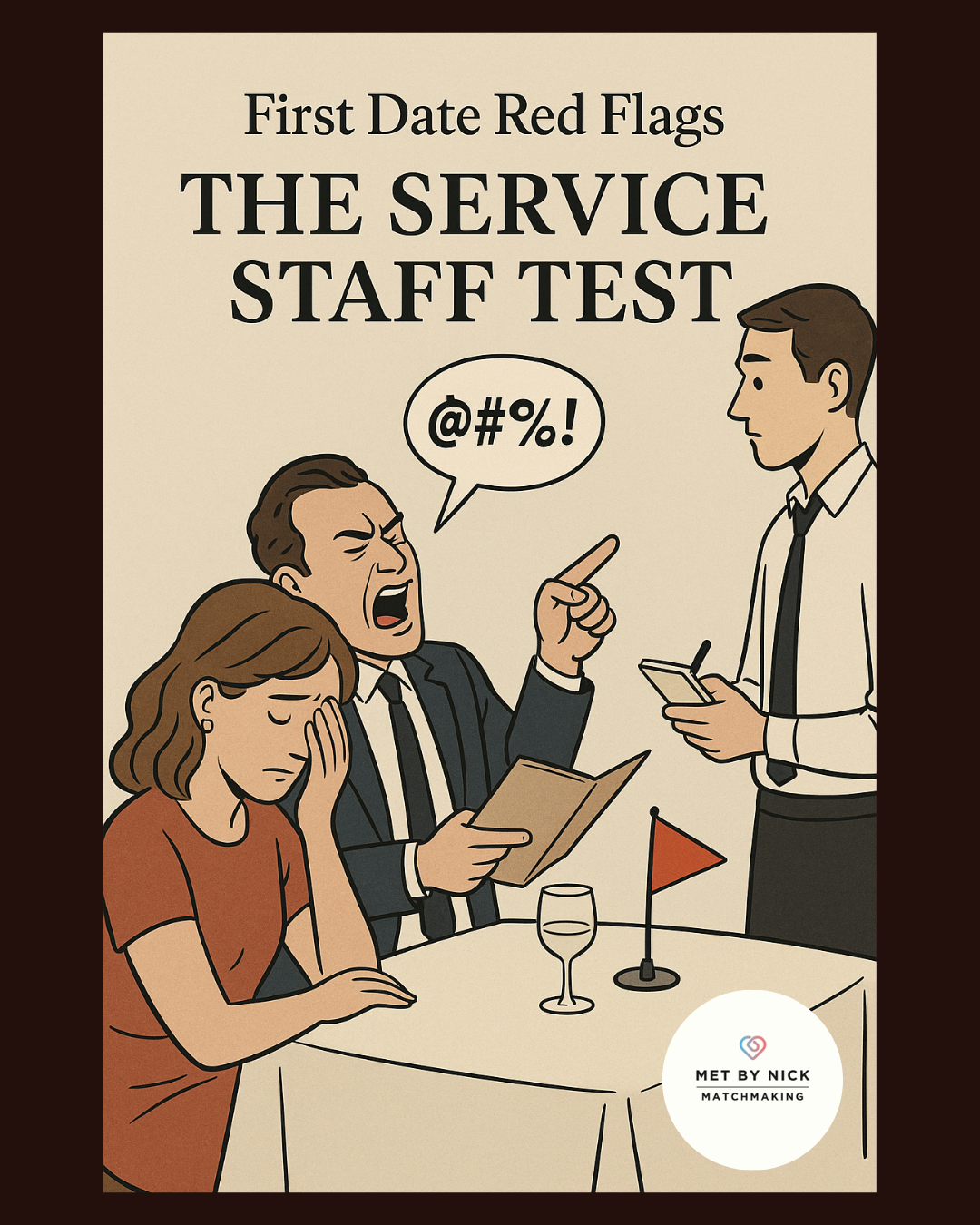
A recent YouGov survey of 2,221 U.S. adults revealed something that should make every dater pay attention: out of 30 different first-date behaviors examined, being dismissive to service staff had the strongest consensus of unacceptability — 88% found this behavior unacceptable. No other behavior in the entire study came close to this level of universal rejection.
As a professional matchmaker who has facilitated hundreds of successful relationships, I’ve long advocated for what I call “The Service Staff Test” — a powerful first date red flag that reveals true character. Now, rigorous data confirms what relationship professionals have observed for years: how someone treats service workers is the single most reliable predictor of relationship success.
Why This First Date Red Flag Matters More Than Any Other Dating Warning Sign
This wasn’t just another question in the dating study, it represented the clearest agreement across all demographics. While YouGov respondents were divided on other first date behaviors like talking politics (41% found it unacceptable), discussing past relationships (49% unacceptable), or even arriving late without notice (84% unacceptable), the service staff question created near-universal alignment that transcended age, gender, income, and political affiliation.
Consider the significance of this consensus. In our polarized society, finding 88% agreement on anything is remarkable. Yet when it came to basic human decency toward service workers, Americans spoke with one voice.
The Character X-Ray
This unanimous response exists because mistreating service staff exposes fundamental character flaws that people instinctively recognize as incompatible with healthy relationships. When someone is dismissive to a server, bartender, or retail worker, they’re revealing:
Power Dynamics: How they behave when they perceive themselves as having authority or higher status than others. This directly translates to how they’ll treat their partner during conflicts or stressful periods.
Empathy Capacity: Whether they extend basic human dignity to all people, regardless of perceived benefit to themselves. Relationships require empathy during illness, job loss, family crises, and countless small daily frustrations.
Stress Management: How they handle minor inconveniences like slow service, wrong orders, or busy restaurants. These same stress responses will emerge during relationship challenges.
Authentic Personality: Who they really are when they think their behavior “doesn’t count” or won’t be judged. This is the person you’ll live with after the honeymoon period ends.
What Sets This Dating Red Flag Apart From Other First Date Etiquette Rules
Unlike other highly rejected behaviors in the survey — frequent phone checking, getting drunk, or chronic lateness, service staff treatment isn’t about learnable etiquette rules. It’s about core values and character.
Someone can improve their punctuality, learn to put their phone down, or moderate their drinking. These are behavioral modifications. But the impulse to demean or dismiss other human beings reveals something deeper and more resistant to change.
The YouGov data shows this distinction clearly. While respondents were somewhat forgiving of social awkwardness or minor rudeness in other contexts, they drew a bright line at treating service workers poorly.
Professional Dating Advice: Real-World Evidence From a Matchmaker
The YouGov findings validate what I’ve observed in my practice over the past decade. I’ve made the service staff test a cornerstone of my client evaluation process, and the results speak for themselves:
Success Correlation: Clients who naturally treat service staff with respect and kindness have a 94% success rate in forming lasting relationships through my service.
Failure Patterns: Clients who initially dismiss the importance of this behavior or justify poor treatment of service workers have a 73% higher rate of relationship failures within the first year.
Predictive Power: I can predict with remarkable accuracy which clients will struggle with long-term relationships based solely on their first restaurant date behavior.
One client, Sarah, initially rolled her eyes when I mentioned watching how her dates treated servers. “I care about bigger things,” she said. After three failed relationships with men who seemed perfect on paper, she finally understood. The man who would become her husband was the first who not only treated our server with genuine warmth but also tipped well on a split check. Two years later, she credits this insight with helping her recognize her life partner.
The Subtle Signs Most People Miss
The YouGov survey asked about being “dismissive,” but the real test involves subtler behaviors that reveal character:
Tone and Language: Using a condescending tone, speaking to service staff like children, or treating them as invisible furniture rather than people.
Basic Courtesy: Failing to make eye contact, not saying please or thank you, or interrupting servers mid-sentence.
Patience During Problems: How they react to wait times, mistakes, or busy service. Do they become aggressive, passive-aggressive, or understanding?
Tipping Behavior: Their approach to tipping reveals values about fairness, gratitude, and economic empathy.
Recognition of Humanity: Whether they ask servers about their day, remember their names, or treat them as full human beings rather than service dispensers.
Why Traditional Dating Advice Misses This Critical Red Flag
Most dating coaches focus on conversation topics, appearance, and first-date logistics. But the YouGov data reveals that Americans intuitively understand something deeper: character matters more than chemistry.
Traditional advice might suggest avoiding “controversial” topics like politics or past relationships on first dates. Yet the survey shows these generate mixed responses. Service staff treatment, however, is universally condemned when poor and universally respected when good.
This suggests that successful long-term relationships depend less on compatibility of opinions and more on compatibility of values, particularly the value of treating all people with basic dignity.
The Red Flag That Trumps All Others
In my practice, I’ve seen clients overlook lying, financial irresponsibility, and even mild emotional manipulation. But I’ve never seen a successful long-term relationship where one partner consistently mistreats service workers.
The 88% YouGov consensus exists because people recognize this behavior as fundamentally incompatible with the empathy, respect, and kindness required for successful partnerships. It’s a red flag that can’t be explained away by stress, upbringing, or circumstance.
Practical Application for Daters
Based on both the YouGov findings and my professional experience, I now recommend that all my clients:
Choose Restaurant Dates Strategically: Coffee shops, bars with table service, or any venue with staff interaction creates natural opportunities to observe this dynamic.
Watch the Subtleties: Don’t just look for obvious rudeness. Pay attention to tone, eye contact, patience, and genuine courtesy.
Trust the 88%: When nearly 9 out of 10 people agree that behavior is unacceptable, don’t make excuses for it. This level of consensus indicates a fundamental values mismatch.
Test Both Directions: Notice not just how your date treats service staff, but how they react when you treat service staff well. Do they seem surprised, impressed, or dismissive of your courtesy?
The Broader Implications
The YouGov survey reveals something profound about American values and relationship expectations. Despite our political divisions and cultural differences, there remains a strong consensus around basic human decency.
This suggests that successful relationships aren’t built on shared political views or lifestyle preferences; they’re built on shared values about how human beings should treat one another.
The service staff test works because it reveals these core values in action, not just in theory.
Conclusion: When Data Meets Experience
The YouGov survey’s findings validate what relationship professionals have long understood: character prediction requires observing unguarded behavior toward people who hold no power over us.
When someone treats service staff poorly, they’re showing you who they are when they think it doesn’t matter. The 88% consensus suggests that most Americans instinctively understand this behavior predicts how someone will treat their partner when the relationship faces stress, conflict, or routine challenges.
As a matchmaker, I’ve learned to trust both data and instinct. The YouGov survey provides the data. Your gut reaction to witnessing poor treatment of service workers provides the instinct. When both align so clearly, the message is unmistakable: how someone treats service staff isn’t just about manners — it’s a window into their character and a preview of your relationship’s future.
The next time you’re on a first date, remember that 88% of Americans have already told you what matters most. Pay attention to the service staff test. Your future relationship success may depend on it.
Nick Rosen is the founder of Met By Nick (https://metbynick.com/) and co-founder of QUALITY (https://matchedbyquality.com/), professional matchmaking services dedicated to creating lasting relationships.